
Criminal Cases in the Marion County Courts
Marion County is Oregon's Third Judicial District. The Marion County Circuit Court hears state felony and misdemeanor prosecutions. Its Downtown Courthouse handles the main clerk and records work, while the Criminal Court Annex holds criminal hearings beside the jail campus. Justice Court keeps deputy-issued citations within its authority. Salem, Keizer, and Woodburn municipal courts retain the matters their charters and state law let them hear. That split means a city citation may not appear in the same local file as a state prosecution.
The clerk is custodian of the filed complaint or indictment, register entries, hearing records, judgment, and sentence. Police narratives and booking records remain with the agency that created them. When an arresting charge and a filed charge differ, the court file is the source for what the prosecutor actually alleged and how the judge resolved it. The broader Marion County arrest history explains the earlier booking layer.
The local court name also points to the right counter. Downtown Circuit Court is at 100 High Street NE, and the Criminal Court Annex is at 4000 Aumsville Highway SE. Marion County Justice Court can be reached at 503-576-7200 for matters within its citation jurisdiction. Salem Municipal Court handles authorized misdemeanor, violation, traffic, parking, ordinance, and state-law matters, while Keizer and Woodburn keep their own limited municipal dockets. A statewide name result should always be opened far enough to confirm which one of these courts owns the file.
Marion County OJD Case Search
The free OJD Records and Calendar Search provides basic case, event, and scheduled appearance information. It can search Marion County alone or look across Oregon courts. A case number is the cleanest key. A legal name works when the number is unknown, but common names need a filing date or court filter. Free results generally do not include the underlying documents.
The official search interface shows how the statewide layer is arranged. Its Records and Calendar Search screen is pictured below.
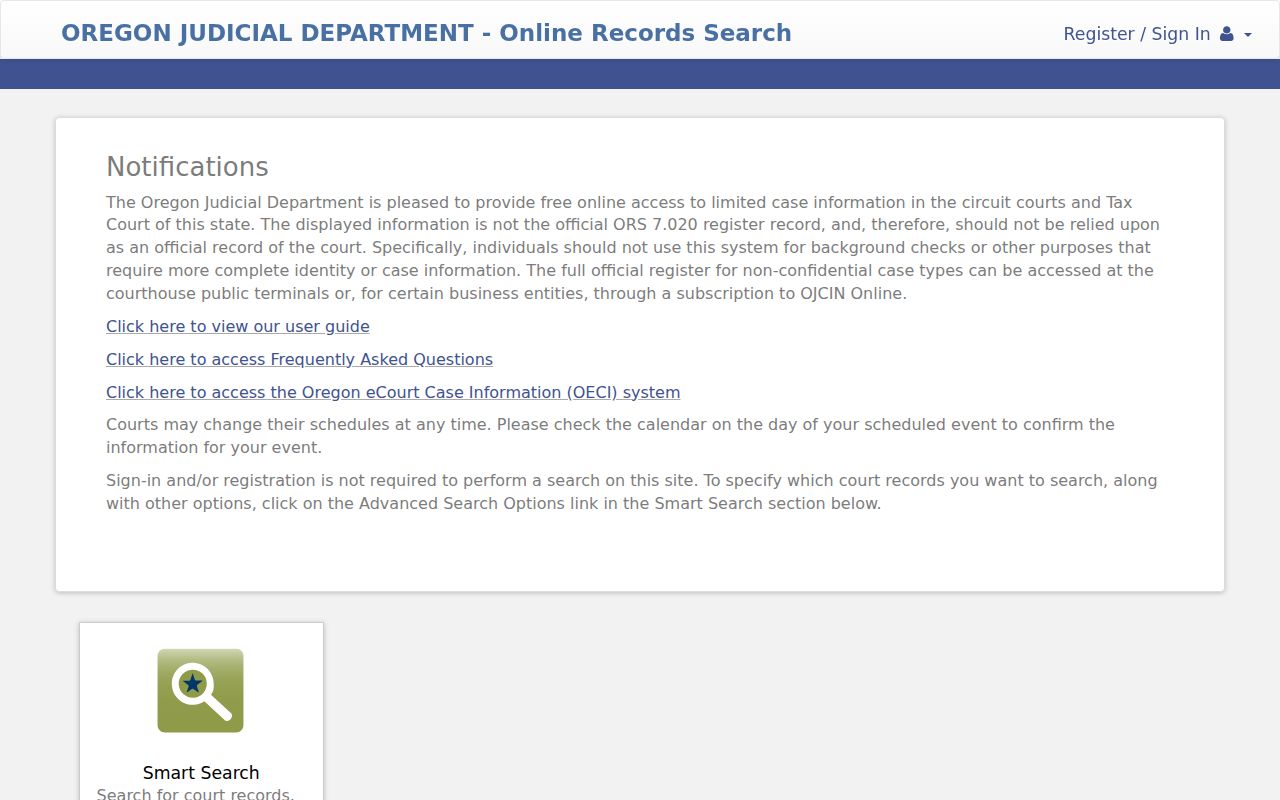
The statewide scope helps when a Marion County arrest leads to a filing elsewhere or when a name search needs to distinguish several court records.
How to Search Case Records
Begin with the narrowest reliable identifier, then confirm the party, charge, and court before relying on an event line. The Marion County clerk can supply copies once the exact case and document are known.
- Open OJD Records and Calendar Search and choose a record-number or party-name search.
- Select Marion County when the filing court is known, or keep the search statewide when it is not.
- Enter the case number or legal last name, then add first name and a useful date range.
- Open the matching register and review charge status, hearings, disposition, and judgment entries.
- Use the Marion Circuit Court request form, mail channel, online request, or records counter for a needed copy or audio file.
| Field Label | Type | Required | Notes |
|---|---|---|---|
| Search Type | Tabs or options | Yes | Record number or party/name |
| Court | Dropdown | No | Select Marion or search statewide |
| Case/Record Number | Text | Conditional | Best exact route when known |
| Last or Business Name | Text | Conditional | Use legal spelling |
| First Name | Text | No | Narrows party results |
| Date Range | Date controls | No | Useful for filings and hearings |
Marion County Court Access
Three access tiers answer different needs. Free web search is best for a quick case match and calendar check. OJCIN OnLine offers deeper register access through a paid account, though document access is limited to approved subscriber groups. The six public terminals in the first-floor Marion County records lobby permit no-charge on-site review without a subscription.
Effective September 1, 2025, general OJCIN access without documents carries a $36 base plus $17 per user profile. General access with documents is $117 plus $17 per user, and setup is a nonrefundable $170. Eligibility still controls document access. The official OJCIN overview shown below explains that paid layer.
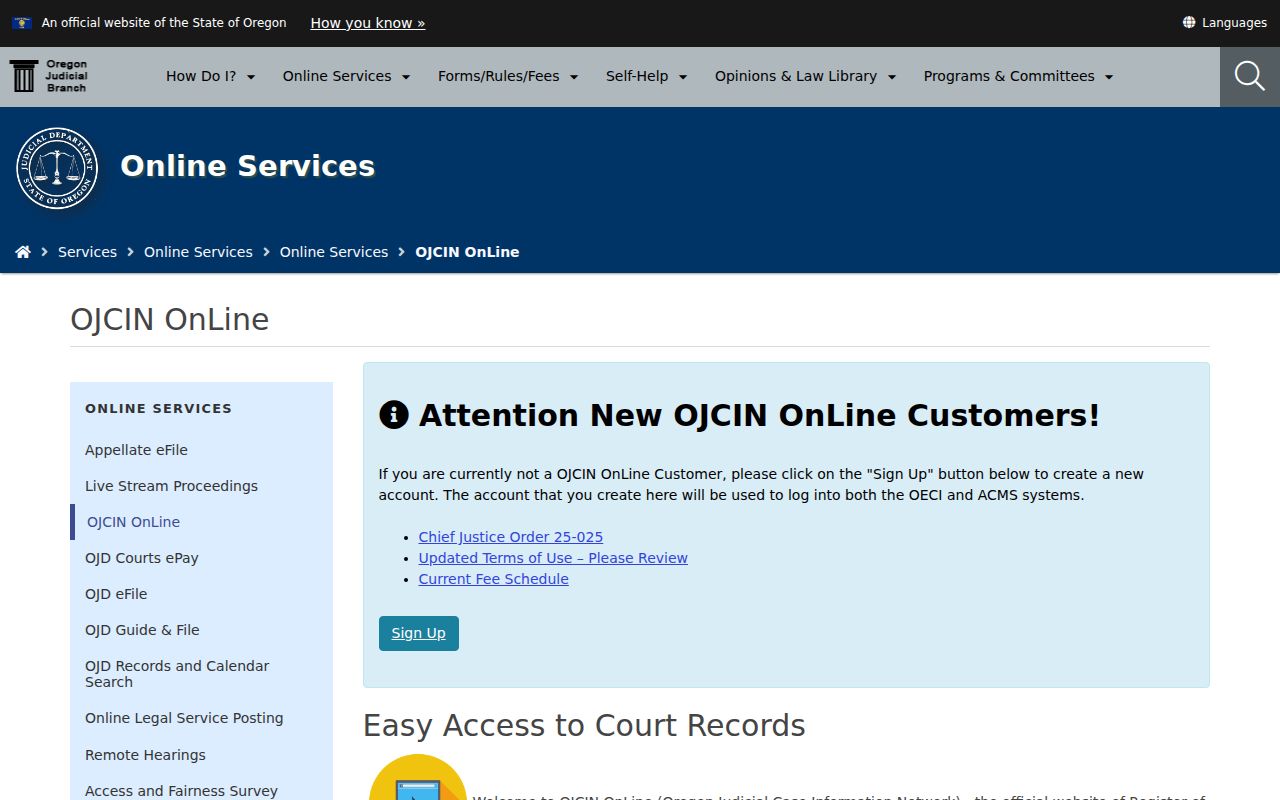
For an occasional Marion County criminal case search, a public terminal may be more useful than opening a subscription.
What the Case File Shows
A case file records the prosecution as filed and heard. Its register is a dated list of events, while the complaint, indictment, motions, plea papers, judgment, and sentencing documents supply the detail behind those lines. Protected birth data, victim or minor information, and sealed material will not appear in the public view.
Match each charge separately. One count may be dismissed while another ends in conviction, so a case-level status alone can hide the result that matters.
| Case Number & Court | Identifies the docket, venue, case type, filing date, and current status. |
|---|---|
| Charging Document | Shows the complaint, information, or indictment and the charges actually filed. |
| Docket Entries | Lists filings, motions, pleas, warrants, hearings, and orders in date order. |
| Hearing Dates | Provides scheduled date, time, place, type, and judicial officer when public. |
| Disposition & Judgment | States whether each charge ended in conviction, dismissal, acquittal, or another result. |
| Sentence & Conditions | Records custody, probation, fines, restitution, and other terms made public. |
Marion County Case Copies
The Marion Circuit Court Records Department accepts online, mail, and counter requests. Give the case number and exact document or hearing date. Standard paper copies cost $3 plus $0.25 per page, certified paper copies cost $5 plus $0.25 per page, and exemplified copies cost $10 plus $0.25 per page. Electronic standard, certified, and exemplified requests cost $3, $5, and $10, with no added email delivery charge. Hearing audio is $10 per day or hearing.
The official Marion County court-record page presents the counter and request choices. Its records request screen appears below.
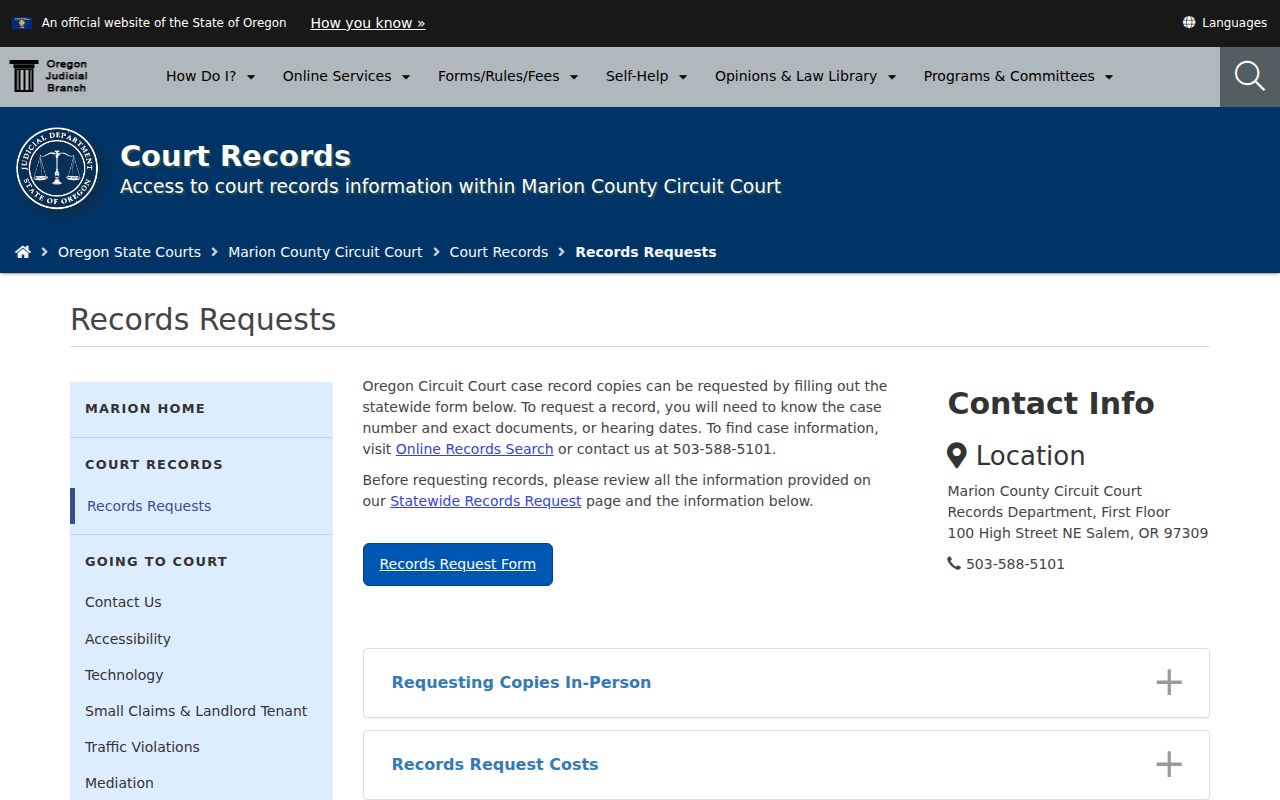
Certified paper copies should remain stapled, and certified electronic copies must be printed in color and left unchanged. Pre-2017 hearing audio is supplied as MP3; later recordings use WMA.
Stages of a Criminal Case
A Marion County court file begins when a charge is filed, not merely when an arrest occurs. Arraignment presents the charge and addresses a plea. Pretrial entries may include release terms, discovery disputes, motions, and scheduled hearings. A plea or trial leads to a disposition. If guilt is established, the judgment and sentencing entries state the final court result and imposed terms.
Case flow: Charges Filed › Arraignment › Pretrial › Plea or Trial › Disposition › Sentencing
A dismissal closes a filed charge without conviction, but it does not by itself erase the police report or booking record held by another Marion County custodian.
Older Marion County Court Files
A missing web result may reflect the age or format of the record. Marion Circuit Court has physical or digital files from 1987 forward and limited microfilm material reaching back to 1910. Older Marion County criminal case work can therefore require a clerk search instead of another online query. Audio holdings reach roughly to 2001, so much older hearings may have no recording available.
The Downtown Courthouse records lobby is at 100 High Street NE in Salem. Its six public terminals are available on weekdays from 8:00 a.m. to noon and 1:00 to 5:00 p.m. The noon closure matters because the building may remain open while the viewing counter is not serving requests. Mail goes to PO Box 12869, Salem, OR 97309, and the records number is 503-588-5101.
Access and Restrictions
Oregon court records are generally open, but public access has firm limits. Oregon Public Records Law allows access to nonexempt agency records and lawful redaction. ORS chapter 181A separately protects criminal-history information except where disclosure is authorized. Juvenile, sealed, victim-identifying, and personal-identifier material may be hidden or withheld.
Online access may show less than a courthouse file. A requester should not ask the clerk to create an analysis or answer a legal question. Identify an existing record instead. A court order under ORS 137.225 may set aside an eligible matter, but eligibility and implementation must be checked in the current law and the court record.
Administrative records without a case number go to the Trial Court Administrator rather than through the ordinary case-copy form. A request for a filed complaint, judgment, register entry, or hearing audio should use the case-record route. This distinction saves a rejected request and keeps the Marion County clerk focused on an existing document. When part of a file is redacted, the public copy may still establish the charge, dates, event sequence, and final disposition without exposing protected data.
Marion County RESTORE Court Cases
Marion County's response to Oregon HB 4002 includes LEAD referrals and RESTORE Court, short for Restitution & Treatment On Route to Expungement. The Marion County District Attorney's HB 4002 page describes the coordinated local route for eligible possession and low-level addiction-driven property matters. It is not a blanket way to remove any case. Eligibility and the actual order control each record.
The court's Marion County treatment-court page shows the named local program setting.
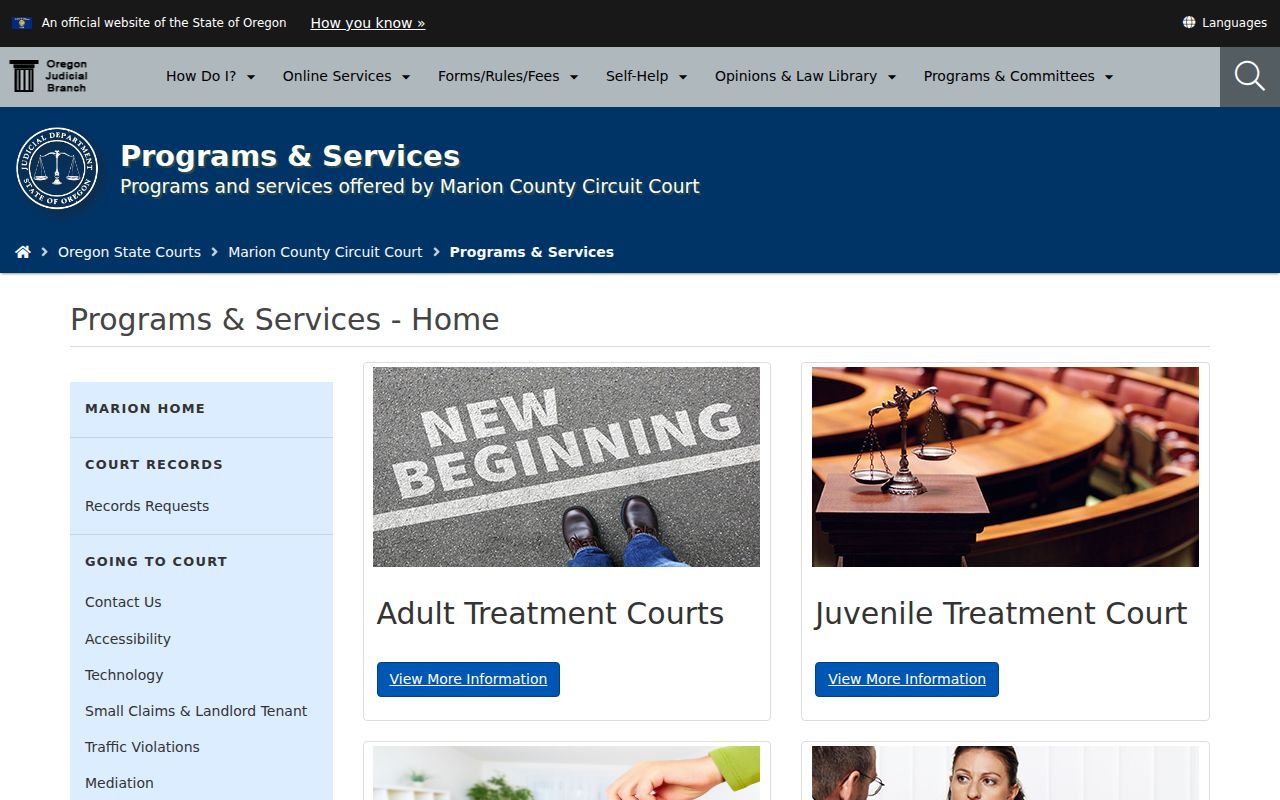
After successful relief, obtain the signed order and verify the Marion County case plus downstream agency records. A program result must be read from the docket and order, not inferred from participation alone.